Journal of Morphology
Volume 22, number 2. June 1911. Pages 307 to 325.
The Ant-Colony as an Organism
William Morton Wheeler
2 August 1910
Wheeler's lecture at Woods Hole.
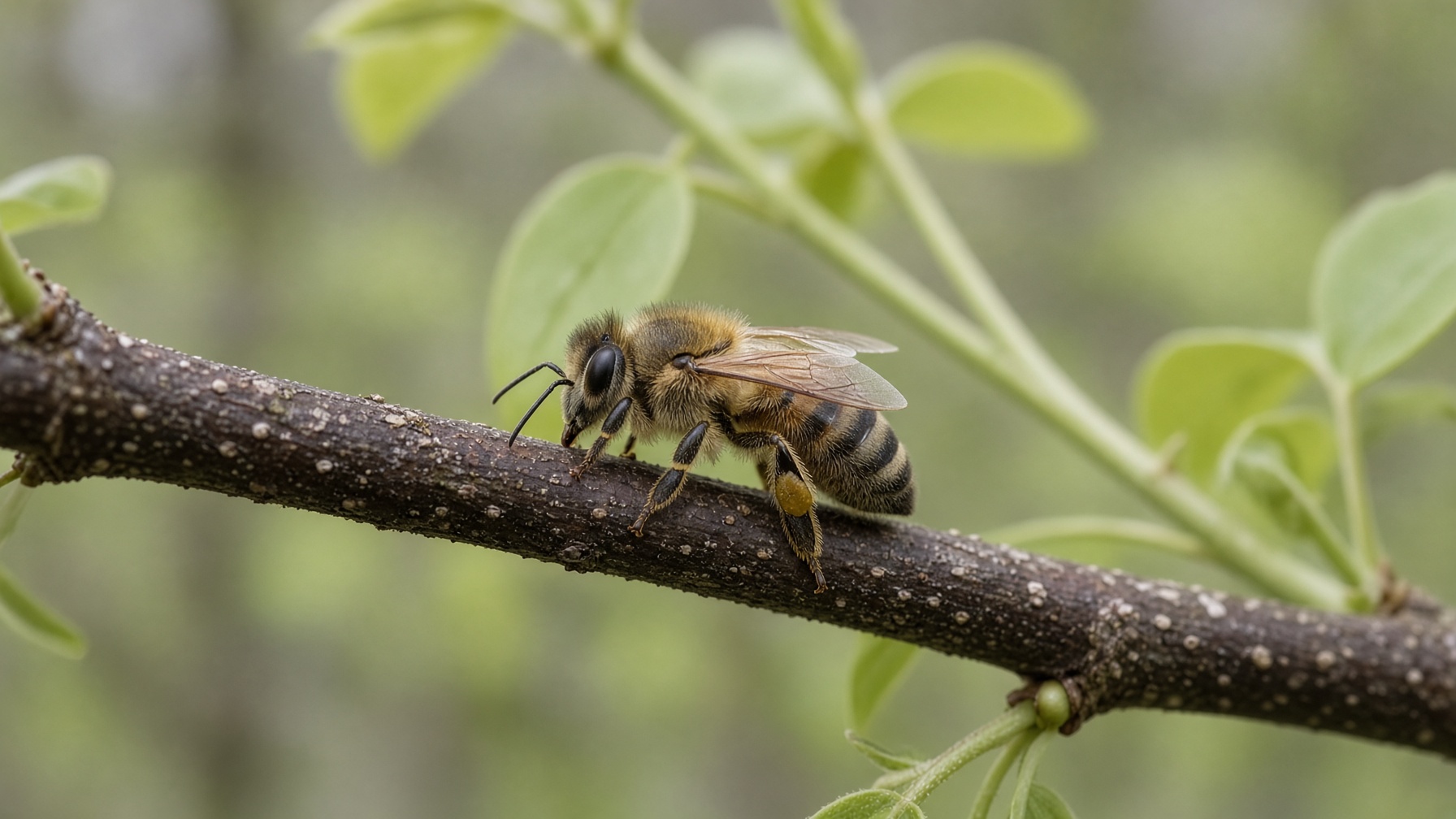
Generated by Grok.
A documentary walk
What becomes possible when no single member knows the whole?
I · The many
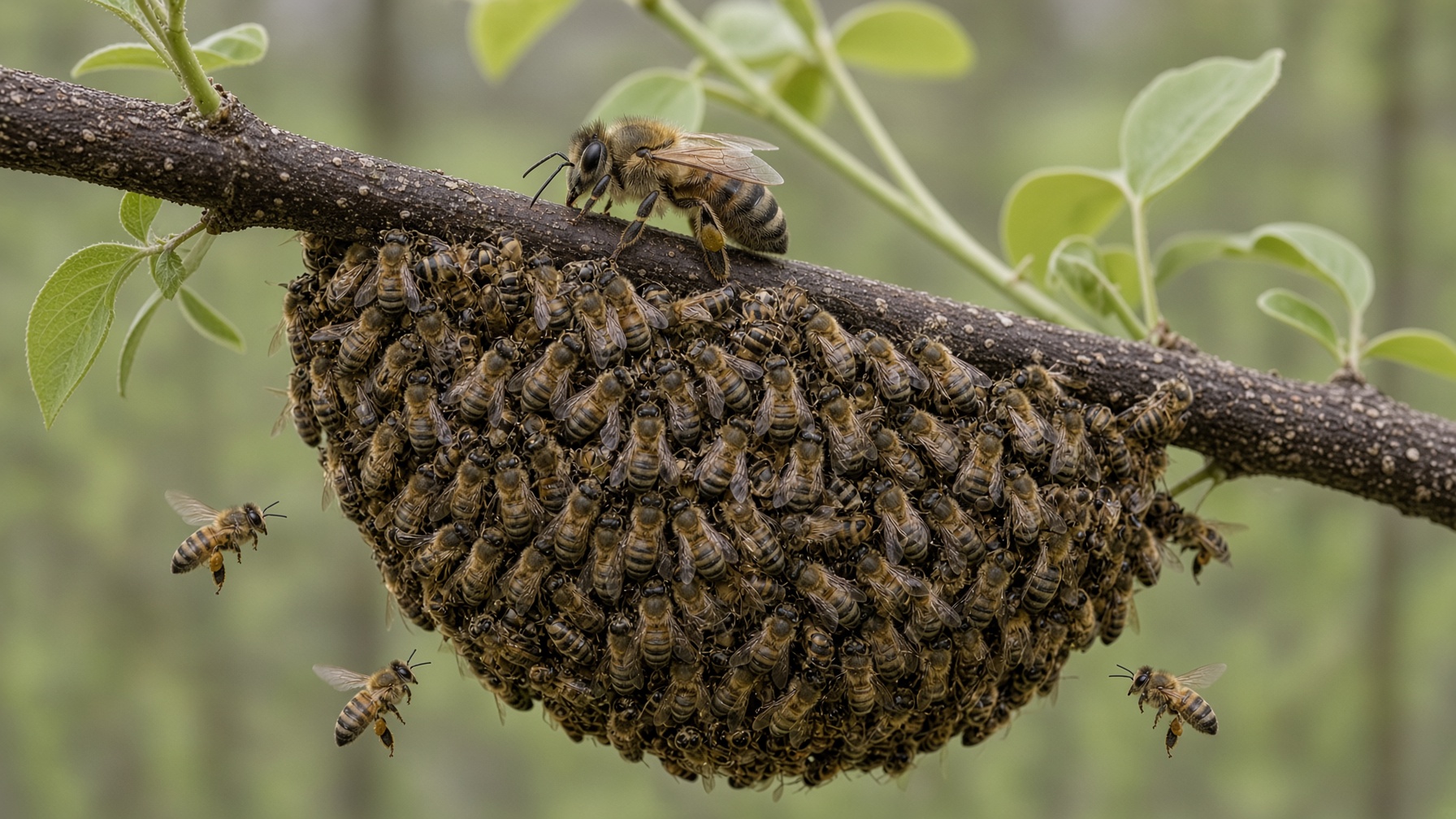
A honeybee on a branch can taste, fly, dance, and interrupt another dancer. She cannot see the cavity the swarm will enter. In spring a colony may divide. The queen and thousands of workers leave and hang together while a few hundred scouts look for a new home. Most of the bees in that cluster have not visited a single site. The scouts have not visited all of them.
Ants, honeybees, and termites also live in societies that outlast any member. Individuals carry limited information. The interactions can still feed the young, hold a nest, and answer a disturbance. Biologists reach for a strong word when that integration is tight. The word is superorganism. It is a claim. It has a history, and it has an edge.
In biology the word names a colony integrated enough to study as one individual. Generations overlap. The young are raised in common. Reproduction is split from the rest of the work. The colony can continue while any worker dies. How far that integration has to go, before the word still fits, is the argument of the next chapter. It is not a rank awarded to every group that cooperates.
A crowd can share a direction for an hour and then go home. A flock can wheel without anyone raising the young. A social network can pass a message and forget who sent it. None of those is what the biological word was built to name.
A moth, met on another walk, follows a cue one animal can sense. This chapter is the other question. How do many animals coordinate when no one of them holds the plan?
Thomas D. Seeley, Honeybee Democracy (Princeton: Princeton University Press, 2010), on swarm departure, scouting, and the cluster that has not seen the sites.
II · The colony as organism
Journal of Morphology
Volume 22, number 2. June 1911. Pages 307 to 325.
William Morton Wheeler
2 August 1910
Wheeler's lecture at Woods Hole.
Wheeler defined an organism as a complex, definitely coordinated, individualized system of activities, aimed at taking in what it needs, producing other such systems, and protecting itself and usually its offspring. He then argued that the ant colony is a true organism, not merely the analogue of a person.
The 1911 title says organism. It does not say superorganism. Jacobus J. Boomsma and Richard Gawne, reviewing the early literature, treat superorganism as a sociological term they date to Herbert Spencer in 1885. Spencer's own chapter heading, already in the 1876 Principles of Sociology and kept when that volume was enlarged in 1885, is Super-organic Evolution. He says he had used the word earlier, in First Principles. The term was still loose when Wheeler wrote. Boomsma and Gawne find the superorganism wording in 1928, in The Social Insects, for a level whose parts he thought more open to inspection than the cells of a body. His underlying claim, they argue, had not changed. He thought a colony with permanent castes was an organism in the full sense.
Eusociality, as Bert Hölldobler and E. O. Wilson stated it, is a different sentence. Adult members belong to overlapping generations, they care for the young together, and they divide into reproductive and less reproductive castes. Suzanne Batra had introduced the term eusocial in 1966. A colony can meet those three features and still be, on Boomsma and Gawne's narrower reading, short of superorganismality until the worker form is a permanent morphological caste, a step they call hard to reverse.
Hölldobler and Wilson pressed the organism comparison, including in their 2009 book The Superorganism. Other biologists answered that the comparison can hide the evolutionary argument. William O. H. Hughes and colleagues argued in 2008 that eusocial lineages began with one mate at a time, which fits kin selection. Wilson's later papers put more weight on selection at the level of the group. That disagreement is about causes. It is not a doubt that anyone has watched an ant.
What the comparison illuminates: reproduction can be concentrated, labor can be divided, and the colony can continue while individuals die. What it does not show: a shared mind, a single bloodstream, or a plan stored in one place in the nest.
William Morton Wheeler, "The Ant-Colony as an Organism," Journal of Morphology 22, no. 2 (June 1911): 307–325, Read the 1911 article. Lecture date 2 August 1910, noted on the article.
William Morton Wheeler, The Social Insects: Their Origin and Evolution (London: Kegan Paul, 1928). Boomsma and Gawne quote the superorganism passage from this book.
Jacobus J. Boomsma and Richard Gawne, "Superorganismality and Caste Differentiation as Points of No Return: How the Major Evolutionary Transitions Were Lost in Translation," Biological Reviews 93, no. 1 (2018): 28–54, Biological Reviews, 2018. First published online 15 May 2017. Their table dates the sociological term to Spencer (1885). Spencer's chapter Super-organic Evolution is in The Principles of Sociology, volume 1, issued in 1876 and enlarged in 1885. In that chapter he says he had used the word in First Principles, section 111. The word in his heading is super-organic. This note was checked against the authorized third edition (New York: D. Appleton, 1898), not against a separate 1885 typesetting. They quote Wheeler, The Social Insects (1928), pages 40 to 41: multicellular integration is "exceedingly complicated and opaque," set against "the very loosely organized social, or superorganisms," in which "the actual play of the components is open to inspection."
Bert Hölldobler and E. O. Wilson, "Eusociality: Origin and Consequences," Proceedings of the National Academy of Sciences 102, no. 38 (2005), PNAS, 2005. The three-part description of eusociality used above is theirs in that paper.
Suzanne W. T. Batra, "Nests and Social Behavior of Halictine Bees of India," Indian Journal of Entomology 28 (1966): 375–393. Standard citation for the introduction of eusocial.
E. O. Wilson, The Insect Societies (Cambridge, MA: Belknap Press of Harvard University Press, 1971). Bert Hölldobler and E. O. Wilson, The Superorganism (New York: W. W. Norton, 2009).
William O. H. Hughes, Benjamin P. Oldroyd, Madeleine Beekman, and Francis L. W. Ratnieks, "Ancestral Monogamy Shows Kin Selection Is Key to the Evolution of Eusociality," Science 320 (2008): 1213–1216.
III · How does the colony know?
A swarm does not hold a meeting. Scouts leave. A scout that accepts a cavity returns to the cluster and dances. Karl von Frisch showed that the waggle dance carries a direction and a distance. In a house-hunting swarm, Thomas Seeley and his colleagues showed a further fact. A better cavity is advertised with more dance circuits. There is no separate word in the dance for excellent. Persistence is the advertisement.
There is also a refusal. A scout committed to one site can butt a dancer and deliver a very short buzz, a stop signal. The dancer may shorten the dance. Whether that changes the choice is what the bars are for.
Quorum here is a count of scouts at one cavity, not a vote of the ten thousand. The line is drawn at 15. Set the cavities. Turn the stop signals on or off. Run it.
Quorum sensing is also the name for an ant's rate of contact, and for a molecule accumulating among bacteria. Switch what is sensed. The line moves.
Seeley and Visscher. The line is 15, the order of magnitude in the 2006 island report. Seeley later wrote of a quorum around 20 to 30. These bars are not the 2012 model.
Dance for a direction and a distance. More circuits for a better cavity. A stop signal can cut another dance short.
Many ants lay a chemical trail that strengthens when a trip succeeds and fades when it does not. The path is in the ground. Temnothorax also leads one nestmate at a time. In the bars, that quorum is encounters inside the nest. Nigel Franks and Tom Richardson described the tandem run as teaching: the follower taps the leader, and the leader waits.
Pierre-Paul Grassé gave the name stigmergy in 1959 to a different route. The builder does not receive a blueprint. A pellet already set down changes what the next builder does. The structure carries the next instruction.
Karl von Frisch, The Dance Language and Orientation of Bees, trans. Leigh E. Chadwick (Cambridge, MA: Belknap Press of Harvard University Press, 1967).
Thomas D. Seeley, P. Kirk Visscher, Thomas Schlegel, Patrick M. Hogan, Nigel R. Franks, and James A. R. Marshall, "Stop Signals Provide Cross Inhibition in Collective Decision-Making by Honeybee Swarms," Science 335 (2012): 108–111, Science, 2012. Published online 8 December 2011.
Krishna Ramanujan, "Study: Swarm bees use 'stop' signals to make decisions, as do brain neurons," Cornell Chronicle, 8 December 2011, how honeybee swarms make decisions. The brain sentence is Seeley's, as reported in this account. The headline's "mimics brains" is the Chronicle's frame.
Thomas D. Seeley, Horace White Professor in Biology Emeritus, Cornell Neurobiology and Behavior. The faculty page names the laboratory.
Thomas D. Seeley and P. Kirk Visscher, reported in "Honeybee Decision-Making Ability Rivals Any Department Committee," Cornell Chronicle, 17 April 2006. The "about 15 or more" figure is this account of the island experiments.
Thomas D. Seeley, "Consensus or Quorum?," The Beelistener, the essay in which he describes a quorum of at least 20 to 30 scouts at the cavity.
Thomas D. Seeley and P. Kirk Visscher, "Choosing a Home: How the Scouts in a Honey Bee Swarm Perceive the Completion of Their Group Decision Making," Behavioral Ecology and Sociobiology 54 (2003): 511–520. They contrast a quorum at the nest site with a consensus of dancers at the cluster. Piping was associated with a buildup of 10 to 15 or more bees at a box.
Thomas D. Seeley, P. Kirk Visscher, and Kevin M. Passino, "Group Decision Making in Honey Bee Swarms," American Scientist 94, no. 3 (May-June 2006): 220. The enigma sentence, that the sensory means of the quorum had not been separated, is this account.
Stephen C. Pratt, "Quorum Sensing by Encounter Rates in the Ant Temnothorax albipennis," Behavioral Ecology 16 (2005): 488–496, Behavioral Ecology, 2005. Touch blocked in a crowded nest. A smaller nest lowered the population at the switch and did not lower the encounter rate.
W. Claiborne Fuqua, Stephen C. Winans, and E. Peter Greenberg, "Quorum Sensing in Bacteria: The LuxR-LuxI Family of Cell Density-Responsive Transcriptional Regulators," Journal of Bacteriology 176, no. 2 (January 1994): 269–275. The naming paper for the bacterial term.
Rosemary J. Redfield, "Is Quorum Sensing a Side Effect of Diffusion Sensing?," Trends in Microbiology 10, no. 8 (August 2002): 365–370. She argues the autoinducer may report diffusion rather than a census.
Nigel R. Franks and Tom Richardson, "Teaching in Tandem-Running Ants," Nature 439 (2006): 153.
Pierre-Paul Grassé, "La reconstruction du nid et les coordinations interindividuelles chez Bellicositermes natalensis et Cubitermes sp. La théorie de la stigmergie," Insectes Sociaux 6 (1959): 41–81.
IV · When one part is disturbed
Groom the neighbor
Uncap the cell and carry it out
Exposed workers stay off the brood
A colony is easier to infect than a solitary insect. Bodies touch. Food is shared. The young sit together. In 2007 Sylvia Cremer, Sophie Armitage, and Paul Schmid-Hempel used social immunity for the colony-level defenses that answer that risk. The defenses are behavioral, physiological, and organizational. Some are always in place. Some begin when something is wrong. They are aimed at keeping a parasite from entering, settling, and spreading.
A honeybee colony can uncap a cell and carry out a diseased larva. Ants groom one another. In garden ants, Line Ugelvig and Cremer found that workers exposed to a fungal parasite stayed away from the brood, while untreated nestmates did more brood care. Contact with the exposed workers also improved the later survival of nestmates challenged with the same fungus. Those are coordinated changes.
A later review asks how those local acts become a colony-level result. In 2018 Cremer, Christopher D. Pull, and Matthias A. Fürst describe social immunity as collectively performed adaptations that reduce the impact of infectious disease. They follow the pieces into avoidance, resistance, and tolerance, and they ask for studies that measure the effect on the colony's fitness. What they measure is coordination.
The defenses can fail. Parasites still move. Colonies still die. The record is of acts.
Sylvia Cremer, Sophie A. O. Armitage, and Paul Schmid-Hempel, "Social Immunity," Current Biology 17, no. 16 (21 August 2007): R693–R702.
Line V. Ugelvig and Sylvia Cremer, "Social Prophylaxis: Group Interaction Promotes Collective Immunity in Ant Colonies," Current Biology 17, no. 22 (20 November 2007): 1967–1971.
Sylvia Cremer, Christopher D. Pull, and Matthias A. Fürst, "Social Immunity: Emergence and Evolution of Colony-Level Disease Protection," Annual Review of Entomology 63 (2018): 105 to 123, the 2018 review. First published online 25 September 2017. The sentences above follow the abstract. The review's case studies are not restaged here as if each had been re-read.
Hygienic removal of diseased honeybee brood is the classic behavioral case. Walter C. Rothenbuhler, "Behavior Genetics of Nest Cleaning in Honey Bees. I. Responses of Four Inbred Lines to Disease-Killed Brood," Animal Behaviour 12 (1964): 578–583.
V · Humanity acquires a nervous system
The biological word has a job. It should still mean that job when the story reaches a microphone.
On the evening of 29 April 2013, at the Milken Institute Global Conference in Los Angeles, Jeff Skoll sat with Elon Musk and Kimbal Musk. The session was called To Infinity and Beyond. The program places it at 7:00 in the evening. In that conversation, the decision to work on the internet in 1995 is told as humanity acquiring a nervous system. The Institute posted the dinner on 1 May 2013, and later an updated copy of the same program. The Elon Musk Archive transcript of that updated recording gives the turn to Elon, timed at 9:29.
He says the thought in 1995 was that the internet "was going to be something really that fundamentally changed humanity. It was like humanity acquiring a nervous system." Before that, people would "communicate information almost by osmosis relative to how the Internet works." Then, in the archive's wording, "it was really just like the humanity was almost becoming like a superorganism with a nervous system."
Those sentences are the archive's speaker labels, not a cleaned caption. Six months later the same memory is in a Stanford transcript that names him without that step. Where a caption and a recording disagree, the recording wins. The 9:29 mark belongs to the archive's copy. It is not stamped onto the Institute's first upload, which is a different file.
29 April 2013 · event
Jeff Skoll with Elon Musk and Kimbal Musk. The Institute posted the recording on 1 May 2013. That is the upload, not the night of the dinner.
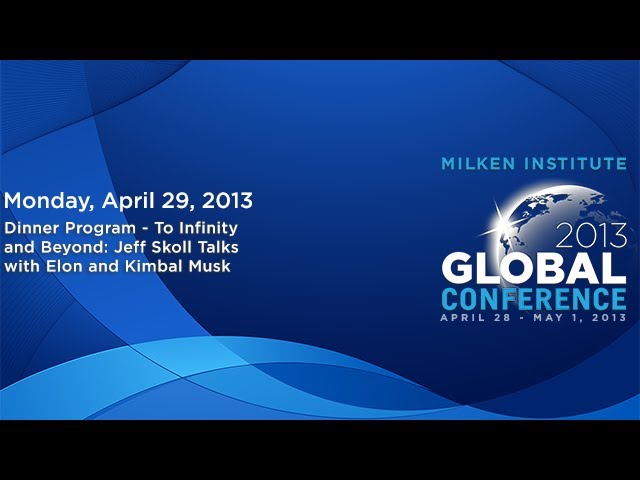
2 October 2013 · event
ENCORE award evening for Tesla. Uploaded 9 October 2013. In Stanford's auto-caption of the talk, Elon says the internet would be "like acquiring a nervous system," that earlier communication would occur "almost by osmosis," and that it would "effectively create a super organism" and "fundamentally change the nature of humanity." The recording remains the authority where the caption stumbles.
Milken Institute, 2013 Global Conference program, dinner of 29 April 2013, "To Infinity and Beyond: Jeff Skoll Talks with Elon and Kimbal Musk," International Ballroom, 7:00 to 9:00 p.m.
Milken Institute, "Dinner Program - To Infinity and Beyond: Jeff Skoll Talks with Elon and Kimbal Musk," YouTube, posted 1 May 2013. The description points to a later upload as an updated version. The Elon Musk Archive plays that updated file and is the transcript used for the quotation above: Milken Institute Global Conference, 29 April 2013. Speaker labels and the 9:29 mark are the archive's. They were read on 27 September 2026.
Stanford Graduate School of Business, ENCORE, 2 October 2013. Full evening posted 9 October 2013. Extract posted 14 April 2014 under the title How the Internet is Changing Humanity.
VI · Human-machine collective
It was like previously, people had communicated effectively by osmosis. And you'd have to basically physically connect with somebody to really communicate-- like a letter. You sent letters on paper. And with the internet, anyone who had a connection anywhere in the world would have access to all the world's information, just like sort of a nervous system. So humanity was effectively becoming a super-organism, and qualitatively different than what it had been before. And so I wanted to be part of that.
The evening was the Entrepreneurial Thought Leaders series. John Hennessy, then president of the university, introduced it. Stanford posted the full talk on 11 December 2015. That is the upload. The conversation was 7 October. Earlier that night he named what he found most remarkable about the present: the internet, and access to all the world's information from anywhere. The transcript has him say, "So having a supercomputer in your pocket is, I think, something people wouldn't have predicted in Back to the Future." External memory, and a fast channel.
On 6 September 2018 he sat with Joe Rogan for episode 1169. The episode was streamed that day. JRE Clips posted an excerpt the next day that carries the passage on companies and networks. One sentence is stable in the auto-caption and in written accounts of the hour: "A company is essentially a cybernetic collective of people and machines." He goes on to describe Google, and the humans connected to it, as one cybernetic collective, and says the same kind of thing about other social networks. Later in the same stretch he says it feels as if we are the biological bootloader for AI.
A cybernetic collective, in that usage, is a loop of people and machines exchanging signals and storing what no one person holds in their head. That is coordination plus an external memory. It is the sort of thing a nervous-system comparison can point at. Speed. Reach. A place for memory outside the skull.
Wheeler's organism had a germ line and a soma, a nest cycle, and signals someone has counted. A platform has users, servers, and incentives. People log off. Companies split. Collective intelligence, as used here, is a decision or a memory no single member holds. An experience would be something else. These recordings do not show one.
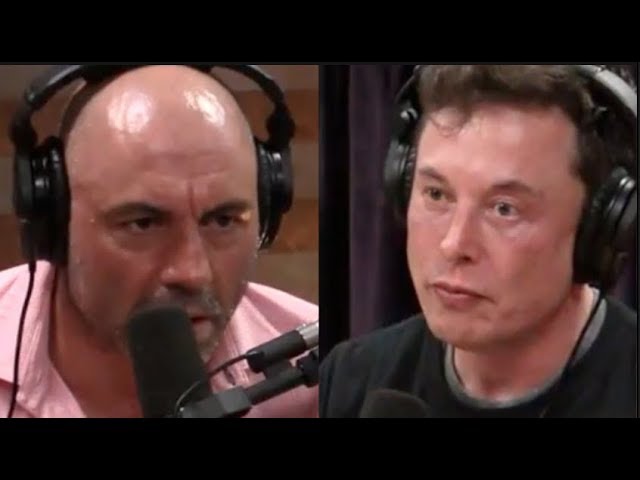
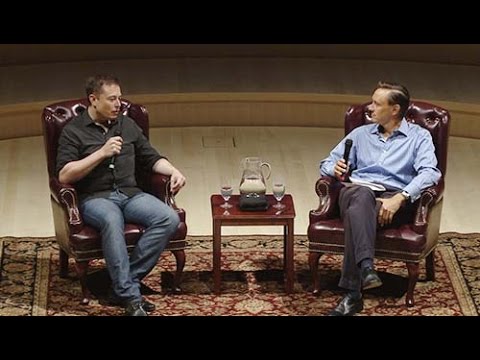
Stanford eCorner, "Elon Musk's Vision for the Future," conversation with Steve Jurvetson, 7 October 2015. Transcript of the full talk and of the clip Switching from Scholar to Entrepreneur. YouTube full talk posted 11 December 2015. The pocket-supercomputer sentence is in the same evening's opening exchange. The long quotation above was checked against the published address of the eCorner PDF of the full talk and against the printable transcript, which opened on 27 September 2026 and carries the same wording, including the transcript's double hyphen. A plain request for the PDF file was refused that day. The printable page is the copy in hand.
Joe Rogan Experience 1169, Elon Musk, streamed 6 September 2018. Excerpt posted by JRE Clips on 7 September 2018. The bootloader sentence is the wording carried by contemporaneous writeups of the episode, including Fox Business on 7 September 2018. The auto-caption agrees on "cybernetic collective" and mangles other words. Where they disagree, the recording wins.
VII · What makes a whole?
Generated by Grok.
In the colony, a whole begins where local signals are reliable enough that the group can feed itself, reproduce, and answer a disturbance without any member seeing the entire situation. That is a narrower bar than cooperation.
In a connected humanity, a message travels farther than a letter. Memory sits outside any one skull. A correction can damp a cascade. Wheeler still required a germ line and a soma. The recordings supply neither, and they do not show that anyone knows the whole.
When does the many beginto behave as one?